The Hong Kong University of Science and Technology (HKUST) has set a new institutional record by securing over HK$279 million for six research projects across all three flagship schemes of the Research Grants Council (RGC) under the University Grants Committee – the highest share in terms of projects funded among universities, cementing its leadership in competitive research funding.
AoE and TRS Sweep:
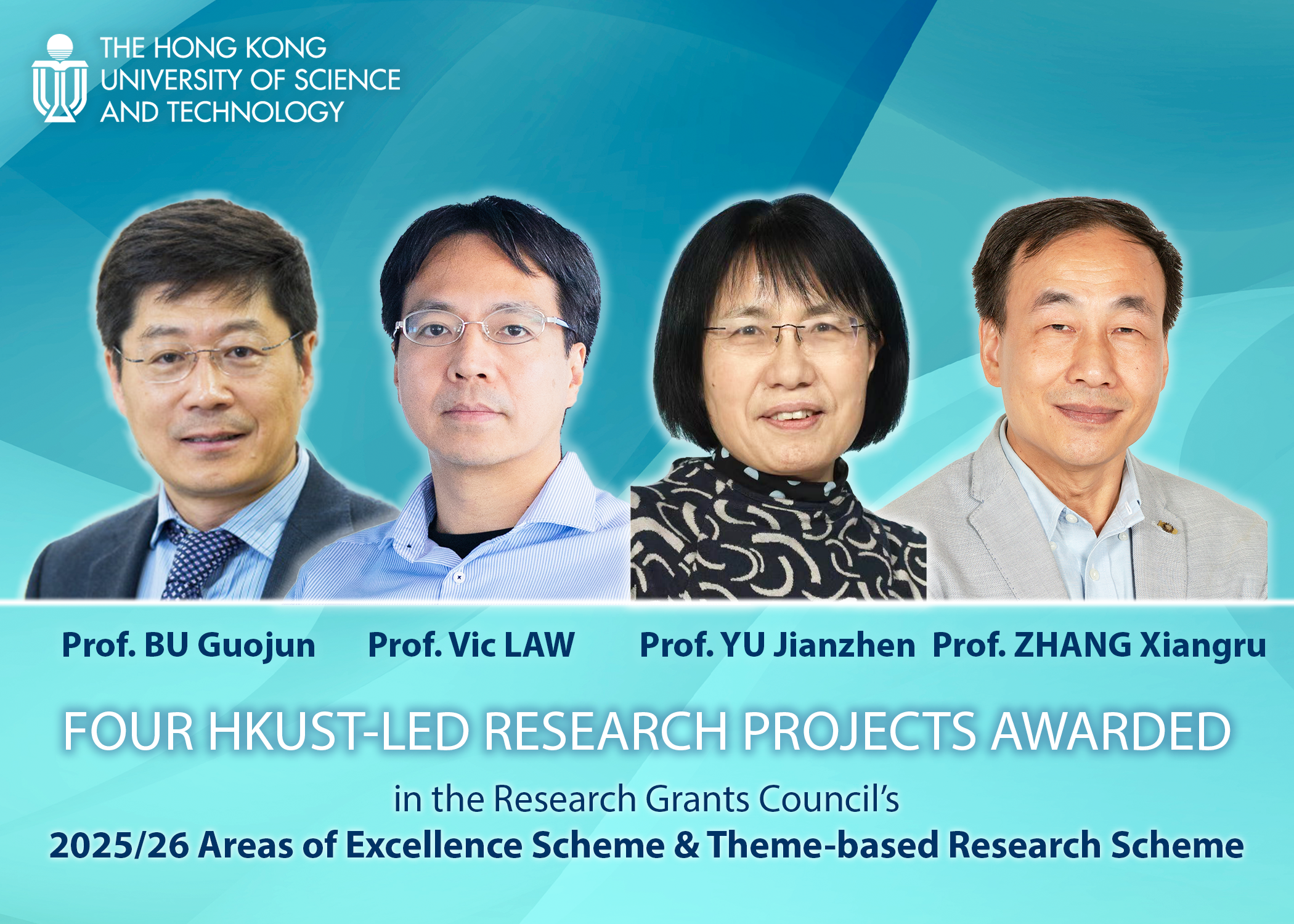
HKUST captured 4 of 9 awarded projects (nearly 45%) in the prestigious Areas of Excellence (AoE) and Theme-based Research Scheme (TRS). These projects target critical global challenges including climate resilience, disease prevention, and sustainable technology.
STG Leadership:
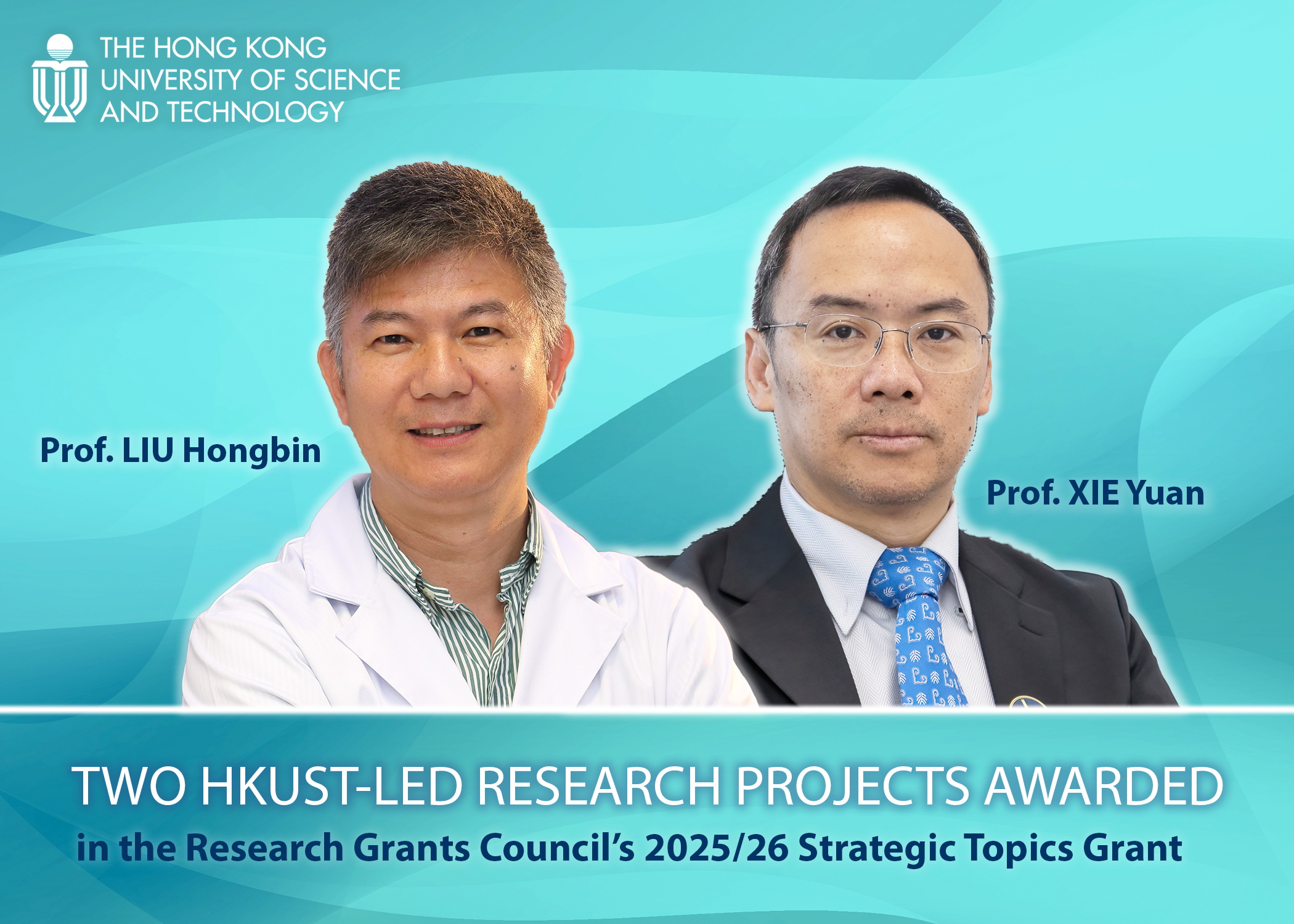
HKUST won 2 of 5 grants (40%) in the 2025/26 Strategic Topics Grant (STG), claiming both the largest funding share and highest project count locally. Initiatives include blue carbon ecosystem conservation in Hong Kong and the Greater Bay Area and cutting-edge integrated circuits chip architecture based on RISC-V for future embodied robotics systems.
Congratulating the research teams, HKUST Vice-President (Research & Development) Prof. Tim CHENG said, “HKUST’s achievement of securing the MOST projects across all three flagship RGC schemes solidifies our leadership in large-scale transformative research—a tremendously encouraging milestone. The record-breaking funding of over HK$279 million not only sets a new benchmark for our university but also underscores our relentless pursuit of breakthroughs across disciplines. As a research-focused institution, our persistent strategic investments in talent, infrastructure, and interdisciplinary collaboration drive cutting-edge scientific advancements, delivering impactful outcomes for Hong Kong, the nation, and the world. We eagerly anticipate these visionary projects yielding transformative results."
The six awarded research projects are:
| Funding Scheme | Project | Principal Coordinator | Approved Budget* |
| AoE |
The Study of Topological and Strongly Correlated Quantum Materials Project Details: This research focuses on novel quantum materials with potential breakthroughs in electronic, magnetic, optical and quantum information devices. Using advanced facilities, the project aims to predict, synthesize and characterize these materials, advancing Hong Kong's quantum research capabilities while developing new technologies and training future experts in this cutting-edge field. |
Prof. Vic LAW, Department of Physics |
$65.415 million |
| TRS |
Identification and exploration of effective and eco-friendly disinfectants from halophenolic DBPs/compounds Project Details: Following the COVID-19 pandemic, global disinfectant use has increased by 50%, posing significant threats to aquatic environments. This project aims to develop novel effective eco-friendly disinfectants (NEED) from halophenolic disinfection byproducts/compounds through a mechanism-driven and AI-empowered identification process, creating patentable and scalable solutions aligned with sustainability goals. |
Prof. ZHANG Xiangru, Department of Civil and Environmental Engineering |
$33.972 million |
|
Neuroimmune Mechanisms and Modulation in Alzheimer’s Disease Project Details: This project investigates how our brain and body’s immune systems affect Alzheimer’s disease. Leveraging cutting-edge technologies, researchers aim to differentiate protective and harmful immune responses. This knowledge will guide the development of targeted treatments to benefit patients, families, and society, while supporting Hong Kong’s healthy aging initiatives and economic growth. |
Prof. BU Guojun, Division of Life Science |
$76.206 million | |
|
Chemical Weather Observations of Carbon Chemistry in Greater Bay Area Project Details: This project establishes a unified chemical weather monitoring network in the Greater Bay Area. By collecting and analyzing comprehensive carbon chemistry data, it aims to enhance the tracking of regional pollution and climate impacts, and to support more cost-effective protection of public health and sustainable development of the atmospheric environment. |
Prof. YU Jianzhen, Department of Chemistry, and Division of Environment & Sustainability |
$53.292 million | |
| Total Approved Budget (AoE & TRS): | $228.885 million | ||
*including funding from RGC and matching fund from universities concerned.
| Funding Scheme | Project | Principal Coordinator | Approved Budget* |
| STG |
Coastal Blue Carbon Ecosystems in Hong Kong and the Greater Bay Area: Carbon Sequestration Capacity, Biogeochemical and Microbial Processes, and Control Mechanisms Project Details: Through investigating the carbon sequestration potential of coastal ecosystems like mangroves and seagrasses in Hong Kong and the Greater Bay Area, the research will analyze these ecosystems' capacity to store carbon while facing environmental threats, develop restoration strategies, and create models to predict their contribution to achieving carbon neutrality goals. |
Prof. LIU Hongbin, Department of Ocean Science |
$31.0 million |
|
Technology-Driven RISC-V AI Architecture Innovations for Emerging Embodied Robotics Systems Project Details: This project develops RISC-V-based AI innovations for robotics, overcoming current architectural limitations through RISC-V's adaptability and in-memory/near-memory computing to enhance AI performance. It investigates advanced chip packaging and novel memory technologies, targeting embodied robotics as AI's future. Outputs will include architectural simulators, design methodologies, open-source IP cores and chip prototypes. |
Prof. XIE Yuan, Department of Electronic and Computer Engineering |
$20.0 million | |
| Total Approved Budget (STG): | $51.0 million | ||
*including funding from RGC and matching fund from universities concerned.